Being of light
Life After LifeThe Being of light is the loving presence at the center of one of the most consequential recurring scenes in Raymond Moody’s account of near-death experiences: a person sees the events of their life, is asked to consider how they have lived, and evaluates their own actions in the presence of a figure who remains accepting. Rather than functioning as a conventional gatekeeper who distributes reward or punishment, the Being of light makes love the measure by which a life is understood.
Place in the near-death experience
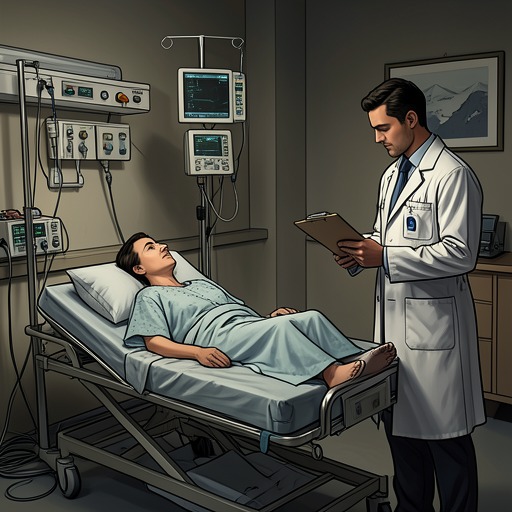
In the theoretically complete model Moody restates, the Being of light appears after a person has reached an apparent afterlife state. The person has heard a doctor pronounce them dead, moved through a tunnel, and found themselves outside their physical body. They have watched resuscitation from a distance and gradually become accustomed to a different kind of body. The arrival of other helpers and the spirits of deceased relatives precedes the appearance of the Being of light, described as a loving, warm spirit of a kind the person has never encountered before.
The encounter gathers the model’s otherworldly details into a moment of personal reckoning. The Being of light asks a question without words, prompting the person to evaluate their life, and helps by showing a panoramic, instantaneous playback of its major events. The model allows that a boundary may then appear, marking the limit between earthly life and what lies beyond. The person is told, in effect, that the time for death has not yet come; despite reluctance to return and intense feelings of joy, love, and peace, they reunite with the physical body and live. Moody presents this as a composite of common elements, not as a sequence that every individual account reproduces in precisely the same way.
The life review and inward judgment
Accounts of the life review vary in scope. Some people say that they saw only major events; others describe seeing everything they had ever done or thought. In either version, the events are presented together, rather than as a prolonged chronological replay. The Being of light is frequently present, and some Christians among the subjects identified it as Jesus Christ. Its question, “What have you done with your life?”, directs attention not simply to what happened but to the motive behind a person’s conduct.
When Moody asked subjects to explain the question, one man expressed its point as whether he had acted out of love for others. In this heightened state, selfish acts brought repentance, while memories of love and kindness brought satisfaction. Moody therefore describes the encounter as judgment in one sense, but emphasizes that the condemnation does not come from the Being of light. The person judges their own actions; the presence remains loving and accepting even as the life is seen in detail. The scene places moral clarity beside mercy rather than making them opposites.
Love, knowledge, and the meaning of the encounter
Two accounts Moody discusses make the emphasis on love concrete. A man in his forties, resuscitated after a severe automobile accident, recalled being asked how far he had learned to love. He understood the question as asking whether he could love people while knowing their faults, without belittling them. A housewife in her late thirties, who suffered cardiac arrest after complications from surgery, remembered being shown what she had done and asked whether she was satisfied with her life. For her, love meant concern for whether a neighbor had food and clothing, and a desire to help if they did not.
Knowledge also enters some of these accounts, but Moody distinguishes it from the dominant concern of the review. The man described knowledge of basic causes and universal principles; the housewife described deeper knowledge related to the soul, or wisdom. Moody observes that love was emphasized most, while learning appeared more casually, as something that would continue beyond death. The Being of light thus appears in reports that connect ethical conduct with understanding, without making the two equally prominent.
Religious interpretation and public use
The scene has prompted questions about whether the life review resembles a religious judgment. Moody contrasts it with the traditional image of a St. Peter-like authority deciding whether someone may enter the afterlife: in the experiences he studied, the judgment arose within the person, while the Being of light continued to love them. He also argues that these reports do not establish or rule out a Final Judgment. Since the end of the world has not occurred, a report claiming to have witnessed that event during a near-death experience would, in his reasoning, undermine that report; interviewees who believed in a future Final Judgment based that belief on scripture, not on knowledge gained during their experiences.
A minister described using the motif in sermons to connect faith with conduct. Speaking at a funeral, he said that the deceased woman had gone to be with her husband and Jesus Christ, and that he meant this literally; around ten people afterward complimented him, an unusual response after a funeral. He also said that presenting Christ as asking how people had loved could affirm faith and direct listeners toward love. For this minister, however, the possibility of life after death remained a mystery rather than something science could prove without changing the role of faith. The Being of light therefore serves in the book both as a recurring feature of reported experience and as a point where questions of moral self-examination, religious belief, and the limits of proof meet.